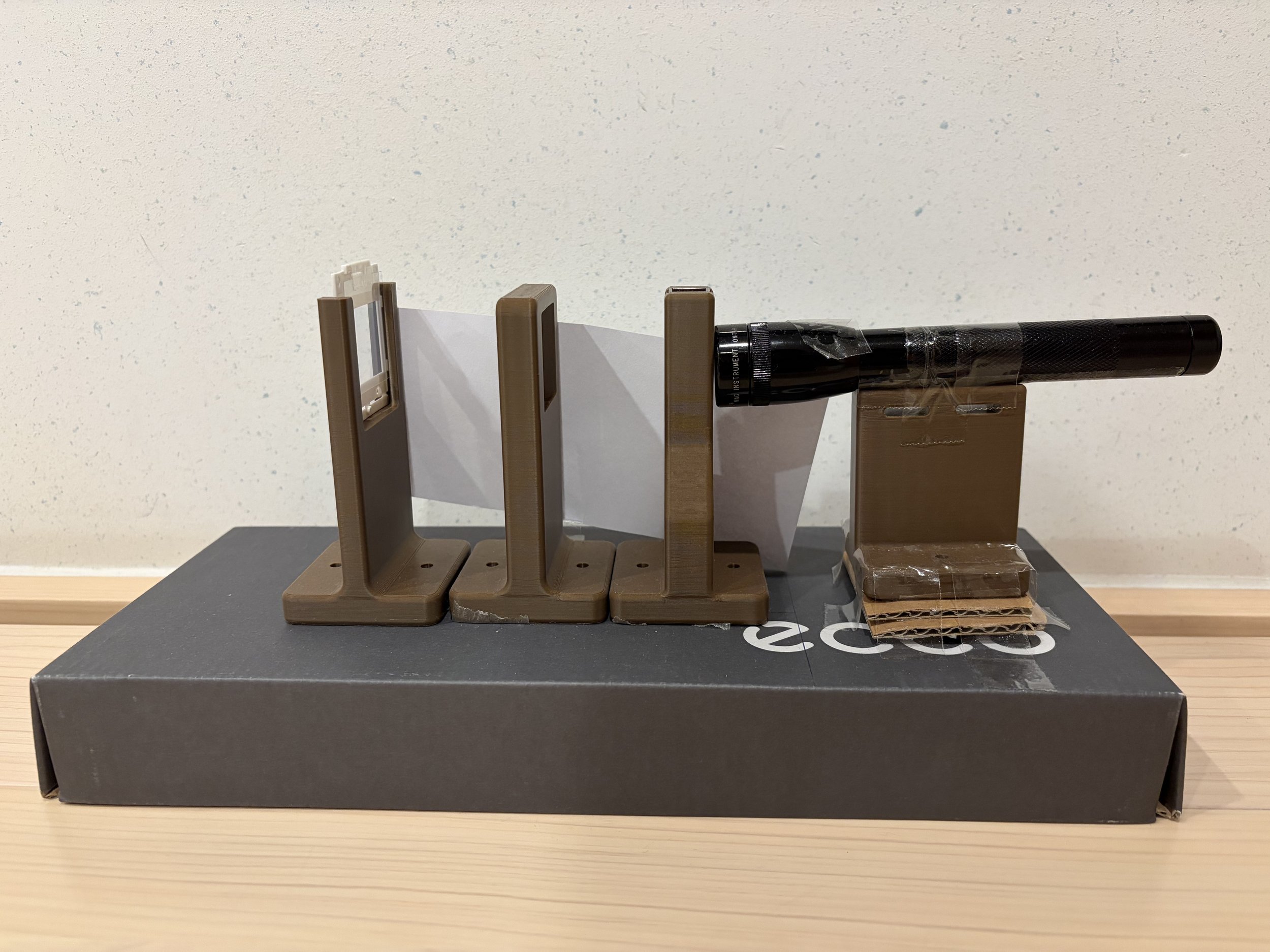
Absorption Spectrometer
This project details the development and assembly of a functional absorption spectrometer utilizing custom 3D-printed components, a transmission diffraction grating, and a broadband flashlight light source. Designed as a cost-effective analytical tool, the instrument functions by passing light through a liquid sample and dispersing the transmitted wavelengths via the diffraction grating. The resulting spectral patterns allow for the qualitative analysis of light absorption across different wavelengths, demonstrating the core principles of spectrophotometry, optical dispersion, and analytical chemistry in a compact, accessible format.
Theory
Introduction
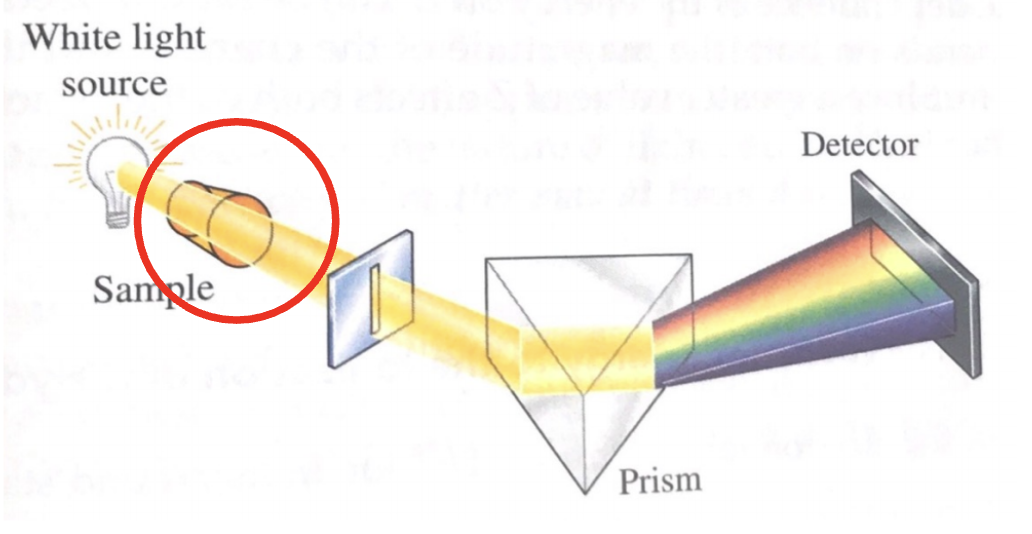
Spectroscopy is an analytical technique used to study how matter interacts with electromagnetic radiation. In an absorption spectrometer, light from a broadband source is passed through a sample. According to quantum mechanics, atoms and molecules in the sample can only absorb photons with energies that match the exact difference between their discrete electronic energy levels.
When these specific photons are absorbed, electron transitions occur, leaving "missing" wavelengths in the transmitted light. By passing this light through a diffraction grating, the light is dispersed by wavelength via constructive and destructive interference, creating a visible absorption spectrum.
Comparing Light Sources: Halogen vs. LED
To get a clear spectrum, the initial light source needs to be as continuous as possible. During experimentation, I compared a standard white LED flashlight with an incandescent halogen flashlight.
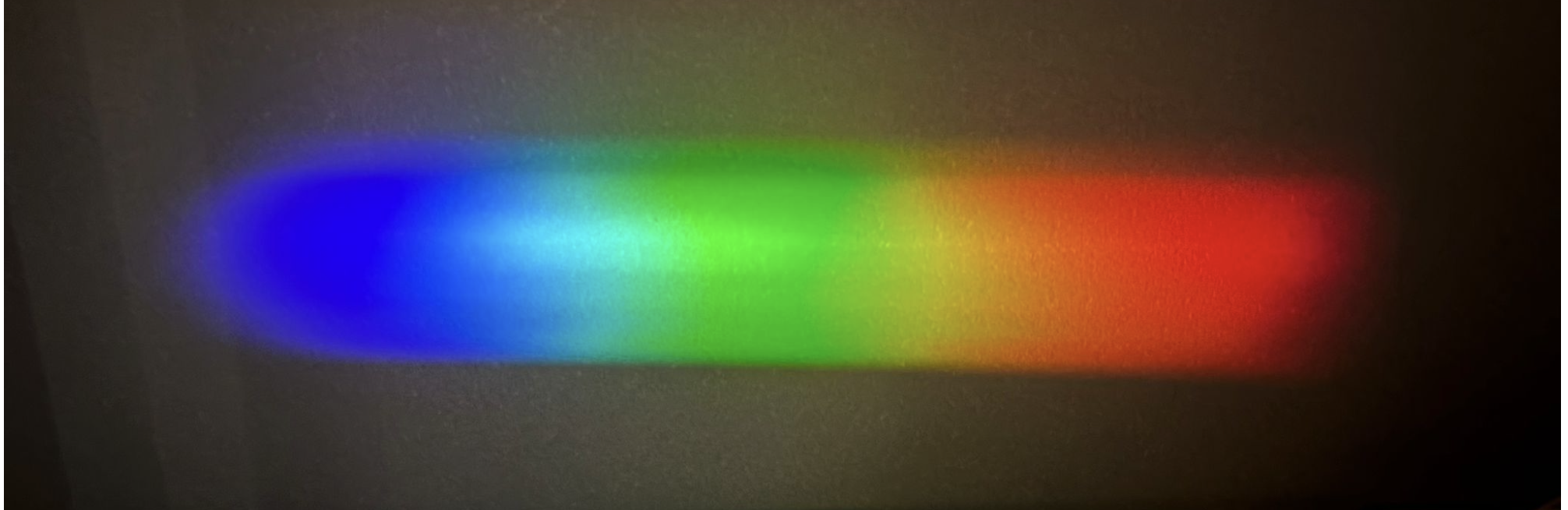
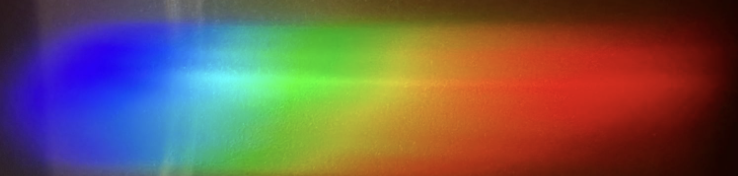
When analyzing the emission mechanisms, a clear distinction emerges between the two light sources. The white LED operates through semiconductor emission combined with a yellow phosphor coating, which produces a discontinuous spectrum dominated by a sharp blue peak and a separate yellow-green band. Because these middle frequencies merge unevenly, the resulting color resolution is relatively poor and muddy. In contrast, the halogen flashlight relies on the thermal excitation of a tungsten filament acting as a blackbody radiator. This creates a beautifully continuous spectrum that forms a smooth curve across all visible wavelengths from 380nm to 750nm, yielding high color resolution with distinct, vibrant transitions from blue to red.
Why I Chose the Halogen Flashlight
While white LED flashlights are highly efficient, their optical properties make them a poor choice for spectroscopy. Most white LEDs produce light by using a blue gallium nitride semiconductor coated with a phosphor material. This results in a highly uneven spectral profile: there is an intense spike in the blue wavelengths (450 nm), followed by a massive drop in intensity before rising into a broad yellow hump.
When this light was passed through my 3D-printed spectrometer's diffraction grating, the resulting spectrum (as seen in the LED test image) was heavily distorted by the blue peak, making it very difficult to clearly distinguish individual color boundaries.
Conversely, the halogen flashlight operates on the principle of incandescence, functioning closely to an ideal blackbody radiator. As electrical energy heats the filament, it emits a smooth, continuous distribution of wavelengths across the entire visible spectrum.
Using the halogen source yielded far better results because:
Clear Color Differentiation: The separation between individual colors—from blue, through green, yellow, orange, and red—was highly defined and distinct on the projection screen.
Experimental Control: Because the halogen bulb's baseline emission is smooth and continuous, any sharp drops in light intensity during future sample testing can be confidently attributed to the sample's absorption properties, rather than an artifact of the light source itself.
Final Product